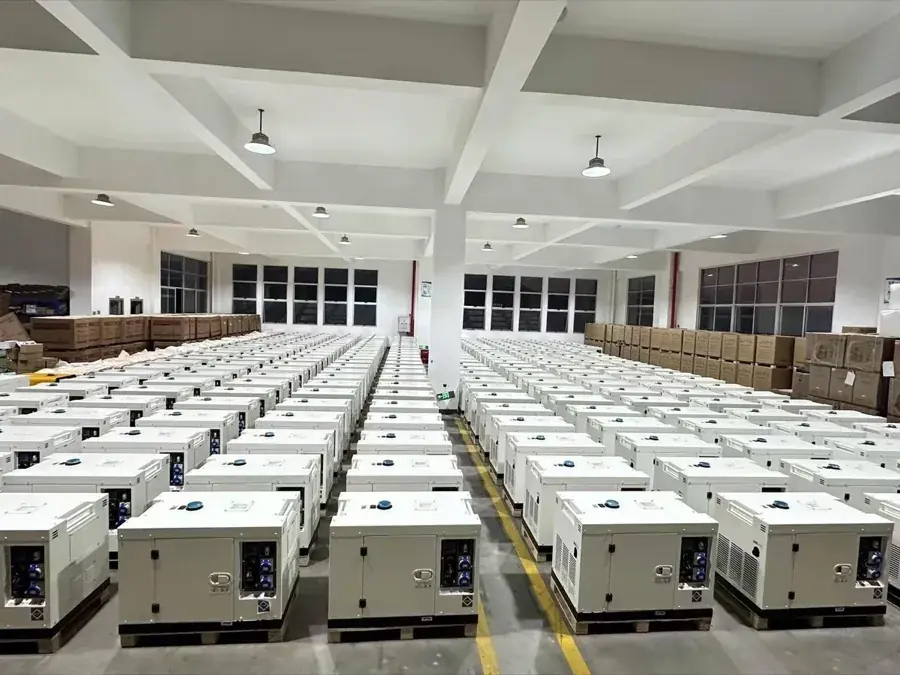
This page is for shop, salon, pharmacy and mini-market buyers who need a compact silent set and want to avoid the two failures that recur on small retail installations: a freezer that will not restart, and a set that cannot be sited anywhere acceptable.
What 8kW buys in a shop
At a power factor of 0.8, a 10kVA set gives about 8kW. In retail terms that is lighting, a payment terminal and computer, a chest freezer or a display chiller, a fan or one air conditioner, and a little left over.
What it is not is a licence to run the shop as though the grid were present. A mini-market with two freezers, a chiller, air conditioning and a bakery warmer will exceed the allowance, and the symptom will not be an obvious overload — it will be a set that runs hot, trips occasionally, and seems to lose capacity in the afternoon.
Retail loads are also uneven through the day. Most of the load arrives in the morning when freezers pull down after overnight, and again in the afternoon when cooling load peaks. A set sized on the average will be undersized for both.
The freezer restart problem
Freezers and chillers are the reason small retail installations trip. After an outage, the compressor tries to restart while the refrigerant pressure has not equalised, so it draws a heavy current and either trips its own protection or drags the generator down.
On a 10kVA set, one freezer restarting is usually manageable. Two or three restarting together, along with the air conditioner, is not. This is the exact moment when a shopkeeper concludes the generator is too small, when the real problem is that everything was reconnected at once.
The remedies are cheap: bring loads back in stages, confirm whether the freezer controls have a restart delay, and avoid putting every compressor on the same circuit so they cannot all start on the same instruction.
Payment terminals and voltage
A shop's most expensive failure is not a dark shop. It is a shop that is open, lit and unable to take payment.
Payment terminals, routers and computers are sensitive to voltage dips. When the generator picks up a motor start and the voltage sags briefly, a terminal may reboot, a router may drop its connection, and the queue stops moving. It is a small electrical event with a disproportionate commercial cost.
Two practical measures help. Keep the terminal and router on a circuit that does not share with the freezers or the air conditioner, and consider a small uninterruptible supply for those two devices. Neither changes the generator rating, and together they remove the most visible symptom of an undersized installation.
Where the set can actually stand
In a lock-up shop the generator usually ends up in a service corridor, on a rear yard, or on a roof. Each of those positions has a different constraint, and the enclosure has to suit the position rather than the other way round.
A canopy in a narrow corridor with one open end recirculates its own hot air and derates. A set on a shared roof needs weather protection and a base that will not transmit vibration into the building below. A set against a neighbouring wall will be heard in that neighbour's premises regardless of the canopy specification.
This is the point at which a silent canopy earns its cost, and also the point at which it cannot compensate for a bad position. Ask what clearance the installation needs before choosing the enclosure, not after.
| Position | Main constraint | What to plan for |
|---|---|---|
| Rear yard | Weather and security | Weatherproof enclosure, lockable, with the discharge clear of the wall. |
| Service corridor | Heat recirculation and noise | Ducted discharge, and enough intake area at the open end. |
| Roof | Base, lifting and vibration | Structural check, anti-vibration mounts, weather protection. |
| Shared wall with a neighbour | Noise and exhaust | Acoustic treatment beyond the canopy, and an exhaust route away from openings. |
| Inside the shop | Not normally acceptable | Exhaust and heat make this a last resort; if unavoidable, duct both outside. |
Fuel in a retail unit
Fuel storage is the part of a shop installation that nobody plans and everybody lives with. A tank inside the shop smells, creates a fire load next to stock, and invites the question of who refuels and when.
A bunded tank in the yard or in a ventilated store is the better arrangement, with a gauge that can be read without opening anything and a shut-off that a member of staff can operate. The refuelling routine matters as much as the tank: a shop that runs dry at 8pm has a problem that no specification solves.
Ask for the tank capacity in the quotation and work out how many trading hours it represents at your expected load. That calculation is more useful than any general statement about fuel economy.
Manual or automatic changeover
A shop does not always need an automatic transfer switch. A manual changeover is cheaper and perfectly workable where someone is always present and knows what to do — but it depends on that person being there.
An ATS removes the dependency and is what most shops choose, provided it is rated for the load and covers the circuits that matter. The practical arrangement is an ATS on the essential retail board — lights, terminal, freezer — and the air conditioner switched manually if the set needs the headroom.
Confirm what the ATS covers, not just that one is included. An ATS wired to the whole board on a 10kVA set will produce exactly the trip that the load plan was meant to avoid.
Buying for resale or stock
Many buyers of this size are dealers adding a compact set to their stock rather than end users. The calculation is different: what sells, what spares are available, and whether the same model can be reordered.
Standardising on one model across a stock order is worth more than a small difference in unit cost, because it means one set of filters, one manual and one set of instructions for whoever assembles and demonstrates it.
Ask for the consumables list with part numbers on the first order. It is the difference between supporting a sold unit and guessing at it.
| Line | Why it matters on a retail site |
|---|---|
| Output in kW and kVA | So the allowance is understood in the units the appliances use. |
| Enclosure and clearance | Because the standing position usually decides the noise outcome. |
| Circuit split | Freezers, terminal and lighting on separate circuits so nothing restarts together. |
| Changeover scope | Which board the ATS or manual switch actually covers. |
| Tank capacity and gauge | So refuelling can be scheduled around trading hours. |
| Consumables list | Filters and belts identified before the first service is due. |
Get a written quotation
Three fields. We reply with the rating, the engine option and the delivery basis.
FAQ
Is 10kVA enough for a shop?
For a small shop with lighting, a terminal, a computer, one freezer and one air conditioner, yes. A mini-market with several freezers, a display chiller and full air conditioning usually needs more, and the honest answer is to count the compressors rather than the appliances.
Should a shop choose silent or open type?
Silent in almost every retail case, because the set stands close to the shop, to staff and often to a neighbour. An open set is only sensible where there is a proper plant space with acoustic treatment and ventilation.
Why does the generator trip when the freezers come back on?
Because compressors restart against unequalised pressure and draw a surge, and they usually do it together after an outage. Staging the reconnection, separating the freezer circuits, or adding a restart delay resolves it more cheaply than a larger generator.
Can a 10kVA generator run an air conditioner?
One unit can be carried if it is sequenced against the freezers. Cooling for the whole shop at the same time as refrigeration usually exceeds a 10kVA set's allowance of about 8kW.
Why do my payment terminal and router restart when the generator takes load?
A voltage dip during a motor start can cause sensitive electronics to reboot. Putting the terminal and router on a circuit that does not share with compressors, and adding a small uninterruptible supply for those two devices, removes the symptom without changing the generator.
Where should a shop generator be installed?
In a position with clear air intake and discharge, weather protection and security. A rear yard or a well-ventilated store is usually better than a corridor or a shared wall, and the position often decides the enclosure rather than the other way round.
What should a shop generator quotation include?
Output in both kW and kVA, the enclosure type and required clearance, the circuit split, the changeover scope, tank capacity with a readable gauge, the consumables list, and whether delivery is FOB China or CIF Lagos.
